Use Figurative Language Like a Native: Get Band 7+ in IELTS Speaking
In the IELTS Speaking Test, achieving a Band 7 or higher requires using less common vocabulary naturally—just as native speakers do. One way to demonstrate this is by using figurative language, such as idioms, metaphors, and similes. In this guide, we’ll show you how to use common idiomatic expressions across different IELTS topics to help boost your score.
Section 1 People
Using figurative Language to describe behaviour
Watch your step
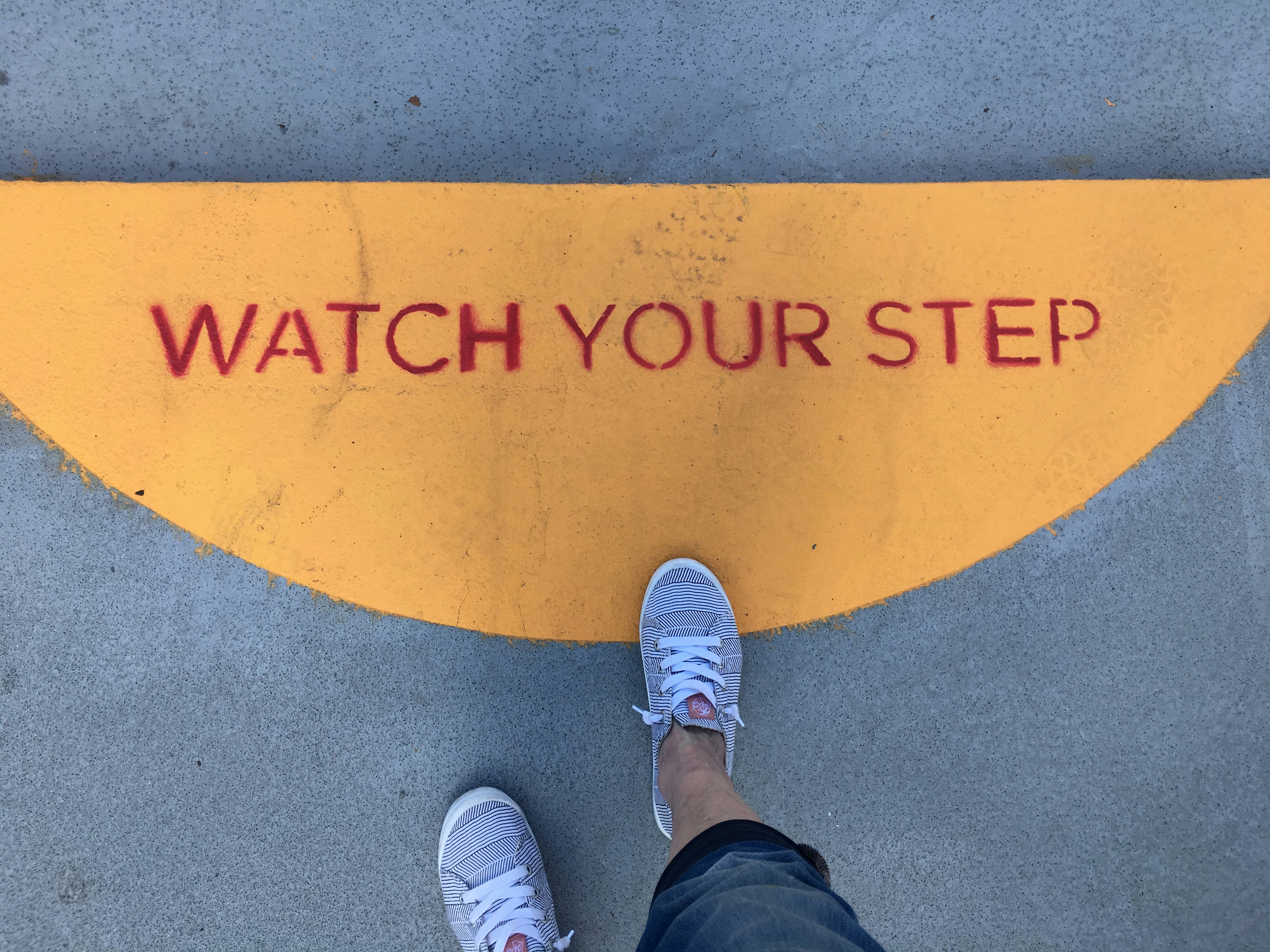
The phrase watch your step can be used figuratively or literally. If you are walking down the street and your laces are undone, or there is a hazard, then someone might warn you to watch your step to avoid an accident. This is the literal use of the term. Equally it can be used figuratively to warn a person that their bad behaviour may get them into trouble. Let's look at a humourous example where a native speaker looks back at a humourous time in his childhood where he confused the literal and figurative meaning of this phrase:
“I remember one time she told me, I came home and I was watching my steps. Like literally watching my steps, because someone had told me you better watch your step. So I was looking at the ground as a tiny child. So going to school can turn some people into a disruptive, antisocial child.”
This phrase could also be used in your IELTS exam. Let's imagine for a moment that you are given a part 2 cue card where you are asked to describe a time when you observed a child being naughty, or acting badly. At some stage in your response you may say:
The child was stamping his feet and his mother was getting increasingly angry. Then things took a turn for the worse when he started throwing toys from the shelf onto the ground, at which point his mother warned him to watch his step, or she would tell his father.
as Good as Gold

As well as it's use in describing bad behaviour, figurative language can also be used as praise. A good example of this is the simile 'as good as gold,' which is often used to describe a child who is well behaved, but can also be used to credit an adult, including older people.
For example, if you are tasked with describing a person who you are pleased to know. It is a valuable metal that has many other positive qualities such as shininess, sturdiness, and resistance to corrosion. So when we describe someone as 'as good as gold,' we are using it to say that they have qualities, but unlike the literal meaning of gold, which suggests it's properties, in the figurative meaning, we are referring to a person's qualities, such as them being genuine, kind, or caring. In addition, we could use it to describe an animal, for example in the case of a dog to describe it's obedient or loyal nature.
'Last year an old lady moved in next door and she had a big alsatian dog which looked really angry and I was a bit scared of. At the start of this year the old lady fell ill and was hospitalised. It turned out that she didn't have any family living nearby so my family agreed to look after the dog until she recovered and returned home. My dad was a bit worried about having a big dog move into our family home, but actually the dog was good as gold, she was a really friendly old thing. I would take her out for walks every morning and she played with me and my sister every evening. In fact, we were a bit sad when we had to hand her back when the old lady came home.'
Using figurative Language to describe admiration
In part 2 of the IELTS Speaking test, you may be prompted to describe someone you look up to. "Look up to" is a phrasal verb, and it means to admire – the verb form of the noun "admiration." We can use figurative language in our response to this...
Using Figurative language to describe a person's background
Handed to him/her on a silver platter

My friend Tony won a place at Oxford University in the year 2000. At that time, most students at Oxford came from wealthy backgrounds, with everything handed to them on a silver platter. Unlike his classmates, however, Tony came from a poor background and had to overcome a series of hurdles to get into university. In fact, he received no financial support from his parents during his studies—neither for tuition fees nor for living expenses.
Fortunately, he was awarded a scholarship from a government fund designed to support students from deprived backgrounds, which covered his tuition. Even so, Tony had to work on weekends to pay for his rent and day-to-day expenses. I'm really proud of him because he succeeded at Oxford against all the odds and even graduated with a First.
The Wrong Side of the Tracks

A student asked me what the opposite of having everything handed to you on a plate, after a bit of thought I decided it was 'Born on the Wrong Side of the Tracks.' This item of figurative language is used to show that a person is from the poorer, less-privileged side of town. Rail tracks often bisect a city through the middle, and this piece of figurative language gives a picture of a city with one side better off, and on the other side of the tracks a poorer part of town. If you can be described as from the wrong side of the tracks, it can be assumed that you come from a poor background and any achievements were made through sheer hard work and determination,
rather than through the support, financial or otherwise of a rich family. Look at the way this item is used to boost vocabulary in response to the same IELTS cue card.
My friend Joe comes from a very underprivileged background. I wouldn't say he grew up in poverty but he defietetely grew up on the wrong side of town, and while he was growing up his mum and dad struggled to make ends meet. However, Joe had a distinct advantage over his classmates; from a very early age it was clear that he had a gift for maths. On top of this, unlike many young boys who neglect their talents, it was obvious that he was going to make the most of his. By the time he was 16 it had become clear that he was going to follow an academic path.
When he became the first person in his family to go to university. After he had finished he went on to do a Masters and PhD. Although I lost touch with him I heard, on the grapevine, that he had become a senior lecturer at the same university he started his higher education at all those years ago.
Section 2 - Places
Using figurative language to describe peace and quiet and quiet places
In our IELTS exam we are often asked to describe places, and this is a great chance for us to use some figurative language to boost our score to seven or above. See the below examples for some ideas.
In my own bubble

These days many people have portable devices and headphones in their ears as they walk around town, travel on public transport, or wait in queues. This is a distraction from the world around them and they are often unaware of their surrounding. To be 'in your own bubble' means to be in your own headspace, isolated from what is going on around you. We might also use this expression to describe a situation where you ignore the world around you. Let's look at an example of this from part 1 of the IELTS exam:
Examiner: Do you prefer to spend your holidays in a foreign country or to stay at home?
Although I am quite well-travelled, I actually prefer to stay at home in my own little bubble and relax. After a holiday spent at home I always go back to work feeling refreshed and self-aware. It's much better than spending a week wandering around a foreign city, getting lost, and waiting around in airports.
You could have heard a pin drop

A pin, which we use to sew or to pin items to noticeboards, is a small thin piece of sharp metal. Although they’re sharp and might make you yelp if pricked, they’re so light that dropping one barely makes a sound..
Read on as the following student responds to a Part 2 IELTS Speaking question about a quiet place that you like to go to.
“I am the type of person who struggles to study in noisy places, and unfortunately in my city even the libraries are usually quite busy. However, last year when visiting a friend to study together we visited a beautiful little library in the town centre. There weren't many interesting books, but what they did have was a big study area and there was hardly anyone around so it was dead quiet and you could have heard a pin drop.
Section 3 - Things
Using figurative Language to describe losing or forgetting something
Modern life is very busy and these days most of us carry round expensive gadgets, or equipment such as mobile phones, iPads or Kindles. On the one hand this is a good thing because it means we can keep in touch with relatives and friends, enjoy culture and enjoy entertainment and culture on the go, on the other it means that we have to be constantly vigilant that we don't lose or forget them. Let's have a look below at some language we can use to describe losing or forgetting something.
A False Alarm
Do you know what a false alarm is? In the literal sense it is where an alarm goes off, for examplea fire alarm, but there is no actual fire. When I was at school one of the naughty students in my year set off the fire alarm on purpose because he was angry. This led to the whole school having to take the precaution of following the safety procedures and leaving the classroom to gather together on the school playground. After the teacher's found that it had been set off by one of the students they realised it was a false alarm and we all had to go back to our classroom. This is the literal meaning of a false alarm.
Sometimes we also encounter figurative false alarms, this is where we or the people around us are worried about something, or worried we have done something, when in actual fact there was nothing to worry about at all. Note the correct usage of grammar in this Part 2 Speaking response, including the past perfect, past continuous and past perfect continuous. These narrative tenses give the response a nice flow, and coupled with the use of figurative language and phrasal verbs, mean the candidate is on course for a band 7 at least in this section of the test
“I'd like to talk about one day last summer when I was getting ready for my holiday in Paris. Typically for me I had left everything to the last minute so instead of carefully organising the things I had decided to take I ended up throwing most of it into my suitcase and then putting my tickets, and book in a bag. Then I rushed out to get in the taxi that was taking us to the airport. After we had been travelling for about quarter of an hour it suddenly dawned on me that I wasn't sure if I'd packed my passport or not. I checked my travel bag and my pockets and saw it wasn't there. After we had arrived at the airport I only had about two hours before my flight.
While my friends went to the desk to start checking in I realised the extent of my dilemma. It would take a whole hour to rush home and pick up the passport and then comeback again, or I could look through all my stuff in the hope of finding it. In the end I decided I probably didn't have enough time to go home and get the passport and return in time to check in. My only hope was that I had absent-mindedly thrown it in the suitcase among all my clothes. So, right there, in the middle of the airport, I unzipped my suitcase and started rooting through my things. In the end I was so relieved when I found in between two of my shirts. Although, it turned out to be a false alarm, it was a good lesson to me. I vowed there and then to never leave my holiday packing to the last minute ever again!
Section 4 - Abilities, Skills and Talents
Using figurative Language to describe abilities
Second Nature
When we think of a person's nature we are talking about their inner character, often the way they were born. It is believed that some people have certain character traits, like kindness, a quickness to anger, or having an ear for music; this is the way they were born. Others believe that our characters and abilities are shaped more by our environment, and that anyone can develop into a kind or talented person if pointed in the right direction. What we do know for sure, however, is that if we work hard on a certain skill then we can master it. When we have achieved a state of mastery in something like coding, or football, or a musical instrument, then doing this thing becomes easy and natural. When we have achieved this state we can describe this ability as like second nature.
For example, I was not born as a good footballer, I worked very hard on it and by the time I had reached adulthood, it was easy for me to play and despite my lack of natural talent, kicking a ball around is like second nature to me. I have become good and, it is easy for me to play.
We can use this piece of figurative language in our IELTS test if we are asked to describe a person who is very good at something. Below we see an extract from an IELTS candidate tackling this question, while talking about a friend who has a job in Cybersecurity. Also note the use of past perfect and past simple.
“I have a friend who is a cybersecurity expert. He loves his job because it makes him feel like a detective, he has to look for clues, examine threats and make deductions. The main reason he is good at this job is because he is a coding expert. At university he studied a number of coding languages such as Javascript, C++, and by the time he had finished coding had become like second nature to him. This means that when he is at work he is able to easily detect rogue code and repair his clients' sites.
Section 5 - Events & Celebrations
This section is on using figurative language to describe parties, festivals and special occasions in part 1and two of the IELTS Speaking Test.
Many IELTS speaking prompts ask about celebrations: “Describe a memorable party”, “Talk about a festival you attended”, “What kinds of celebrations do people have in your country?”
In such scenarios you can use figurative / idiomatic expressions to bring your answer to life. Let's explore these topics and provide some examples of figurative language you can use in your test to sound like a native speaker.
Like a Fish Out of Water
Have you ever been fishing? If so how do you think a fish feels when you reel him in and pull him in? You can expect him to feel uncomfortable. to say the least! Most of us, either at school, or in our social life, have been in a position where we feel we don't fit in, either because of what we are wearing, or maybe because we don't have much in common with the people around us. Examine this extract from a Saudi student recounting an experience where he wore a football kit to a formal extended family gathering.
One day last summer I was relaxing at home when I answered a call from my Brother reminding me that we had an important family gathering at 2pm and I needed to come over right away. As it was already 1.30pm, I was running late so I had a shower and threw on teh nearest clothes that were to hand. Unfortunately, these clothes were a Barcelona FC shirt and shorts. When I arrived I noticed that everyone else was dressed in our traditional national costume, it was a much more formal occasion than I imagined. I felt like a fish out of water, and I could see some of the older members of the family were frowning at me. Fortunately, however, my dad and the younger men in the family saw the funny side of it.